
California law provides pathways to care, but many are difficult to access.
People with serious mental illness (SMI) are spiraling through 911 calls, emergency rooms, family homes, the streets, and jails without receiving sustained treatment. Quarter Turn Strategies Institute is a California nonprofit and 501(c)(3) organization. We provide technical assistance to cities, counties, and first responders so they can work together to connect people to the right level of care using the laws already in place.
Our approach works. Our CEO built San Diego’s LIFT Program, which brought EMS, police, and medical providers together to combine existing resources and use existing legal pathways. A department review of the first 18 cases found associated 911 calls fell by more than 90 percent. That is the model for our work: practical fixes built with the agencies that respond every day. Our technical assistance draws on our research on California mental health law, including a white paper on Welfare and Institutions Code section 5200 endorsed by 14 organizations, including NAMI California, the Treatment Advocacy Center, the California State Association of Psychiatrists, and the Lucky Duck Foundation.
Our name reflects our approach. Meaningful change doesn’t require starting over. It needs a deliberate quarter turn, grounded in law and practice, to unlock what has stalled.
What we offer
Technical assistance for cities and counties. We find where people are falling through the gaps between systems, then build practical fixes with you. Support ranges from an initial review (Discovery), to ongoing guidance (Advisory), to launching a pilot program (Pilot).
Training and resources. We train first responders and local staff, present at conferences, and provide resources for families. Our research on California mental health law grounds this work in how the law is meant to operate.
Who works with us
Cities, counties, and first responders who see the same people in crisis again and again.
Nonprofits and health systems that need legal and policy grounding for their programs.
Public officials and staff who want nonpartisan information on how current law operates in practice.
Why donors support us
Your donation funds technical assistance and training for cities, counties, first responders, and families, grounded in independent research built on primary sources such as statutes and county records. We are led by people with direct experience inside these systems, in emergency response, law, and medicine. Our philosophy is outlined below.
Our Philosophy
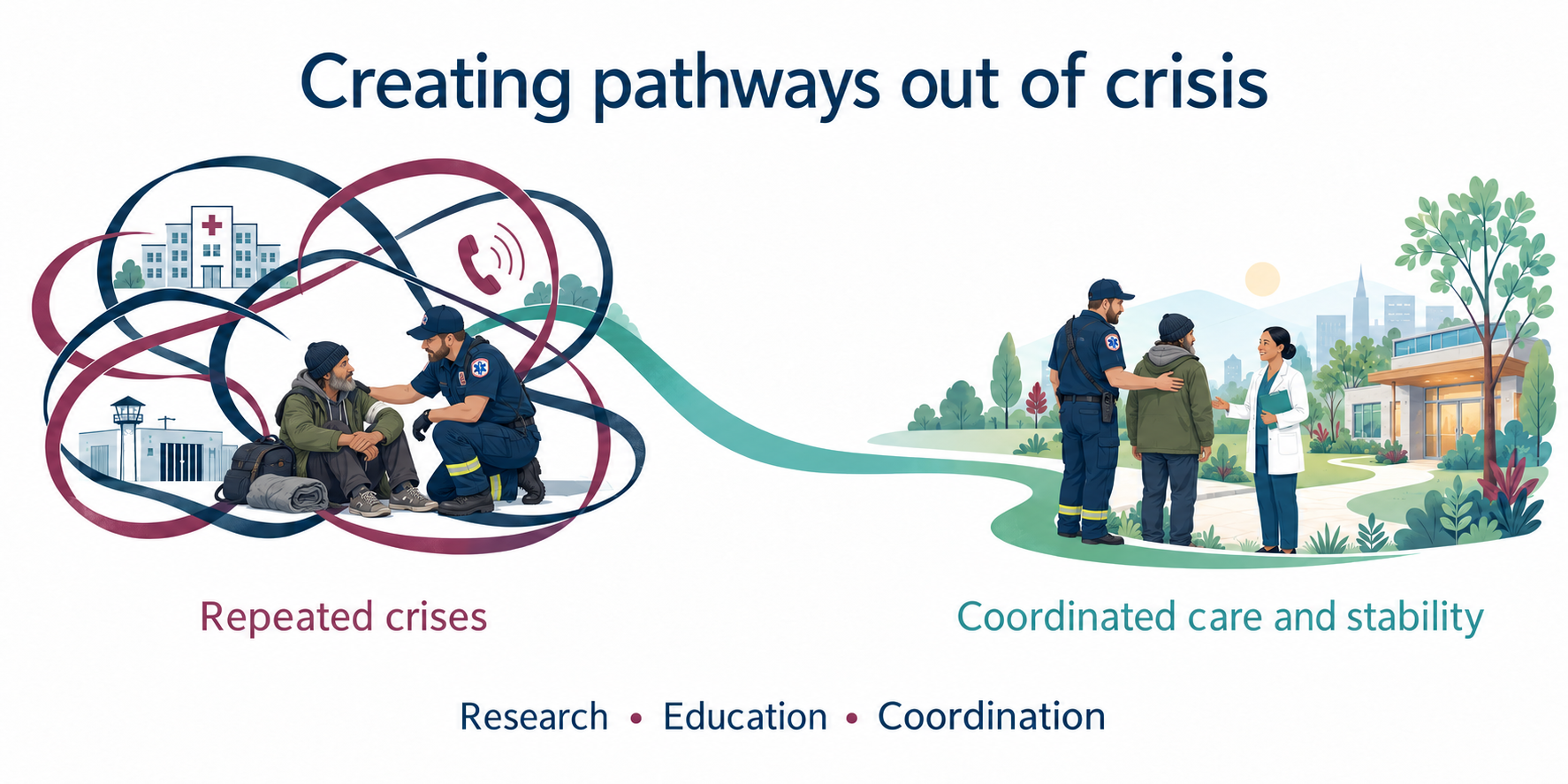
Everyone relies on 911 for urgent needs. Doctors’ offices, clinics, and crisis lines all tell people to call 911 if they need help right away. 911 does not turn anyone away, so it becomes the safety net when a person has not yet been connected to ongoing care.
Firefighters, paramedics, and police often respond to the same people again and again. Many of these people have serious mental illness and/or severe substance use disorders and, as a result, cannot meet their own basic needs. First responders often have no clear pathway to get them the care they need. This leaves patients cycling between systems that were not built to work together, and it leads to compassion fatigue for first responders. Our work focuses on building those missing pathways.
Build Systems for People With Complex Needs
When people with the most complex needs seek help repeatedly through 911, it is a sign they have not been connected to ongoing care. Repeated 5150 holds that do not lead to follow up care are another sign of a gap in the handoff. Strong systems serve people who cannot find their way through services on their own. They also provide care that continues after the crisis ends.
Use Approaches Supported by Evidence
Ending an immediate crisis is not the same as solving a chronic problem. Success means the person received the right care, stayed in treatment, and became more stable over time. Strong systems plan for that from the start.
Provide Person Centered Care
A person’s needs change over time, and care should change with them. The law calls for care in the least restrictive appropriate setting. That standard is about fit, not the fewest services. It means offering the care that fits the person’s needs at that time. When illness keeps a person from understanding that they are sick, a more structured setting may be the appropriate one for a period of time. That care must follow the law, protect the person’s rights, set clear goals, be reviewed regularly, and move the person to less restrictive care when they are ready. Stable housing with the right support is the long term goal.
Understand and Use Existing Legal Pathways
California law already provides several pathways to care. Some are underused, and others are limited because there are not enough beds. We help local agencies understand what the law allows, who has the authority to act, and how to put these pathways to work in practice. The law creates these pathways and protects each person’s rights, but jurisdictions interpret it differently, often because of local resources and legal guidance. Ideally, people would have the same access to care no matter where they live in California.
Build City and County Partnerships
Counties carry the main authority and responsibility for behavioral health treatment, and they do this work with real limits on funding, workforce, and beds. Unmet needs often involve many more services than treatment alone. Cities often run fire, police, and 911 dispatch, and they carry much of the local response to homelessness. People with SMI move between separate city and county systems every day. Lasting solutions come when cities and counties plan, share information, and act together. We work with all agencies to help make that happen.
Build Solutions Through Stakeholder Collaboration
No one agency can see the whole problem. We work with people receiving care, families, clinicians, first responders, public agencies, courts, researchers, and policymakers. Each one has different training and legal authority. When they work together, people with complex needs are less likely to fall outside the limits of any single program.
Build a Complete Continuum of Care
An effective system needs enough capacity at every level of care. That includes evaluation, stabilization, treatment, structured care, step down services, and community support. When one level is missing, people cycle through emergency rooms, 911, homeless services, and jail without getting the care they need.
Measure Outcomes and Then Reassess
Programs and laws should be judged by clear data on access to care, continued treatment, and long term stability. When the data are incomplete, we also listen to the people who provide and seek care. When an approach is not working, partners should find out why and change course together.